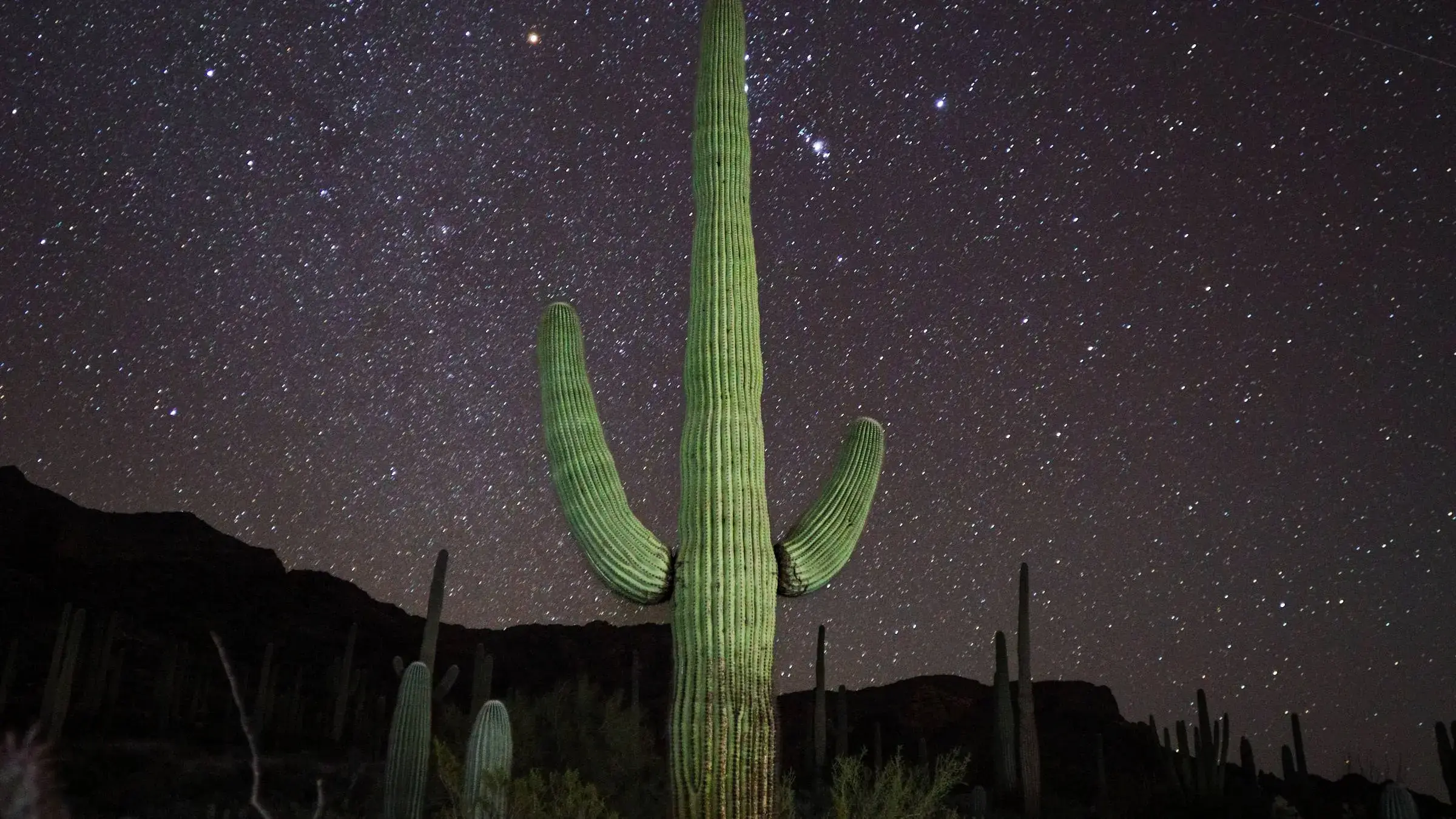
A saguaro cactus is lit by the night sky.(Photo: Getty / CampPhoto)
Just weeks after Customs and Border Protection confirmed that a roughly 1,000-year-oldIndigenous geoglyphhad been damaged amida second border wall expansionin Arizona’s Sonoran Desert, the region finally caught a rare piece of good news. On May 15, Organ Pipe Cactus National Monument, located two hours west of Tucson, was officiallycertified as a Dark Sky Park.
The designation comes courtesy ofDarkSky International, the nonprofit widely considered the governing authority on dark-sky conservation. Organ Pipe now joins a constellation ofmore than 250certifieddark-sky destinationsaround the world, and becomes Arizona’s 12th official Dark Sky Park. The last place to be certified as a Dark Sky Park prior to this wasChimney Rock National Monument.
“Organ Pipe Cactus National Monument protects an extraordinary nighttime ecosystem within one of the most biologically diverse regions in North America, the Sonoran Desert,” Ruskin Hartley, Dark Sky International’s executive director and CEO, toldOutside. “This certification reflects more than a decade of dedicated work by the monuments staff, showcasing incredible determination that has also been reflected through years of public outreach and education efforts.”
To earn the designation, the park had to meet rigorous standards for natural darkness and light pollution mitigation. Staff spent more than ten yearspursuing the certification,collecting months of night-sky monitoring data while steadily reducing artificial lighting around the visitor center and campground. Along the way, the park expanded its astronomy programming with annual star parties, community outreach events, more than 100 evening telescope programs, and, beginning in 2025, an astronomer-in-residence program.
“Organ Pipe represents the very best of the International Dark Sky Places program, demonstrating how collaboration and hard work can not only preserve the nighttime environment, but improve it, enhancing the experience for visitors while protecting critical nocturnal habitat for wildlife,” Hartley said.
For anyone who has stood beneath the monument’s impossible blanket of stars, the recognition feels overdue. Stretching across a remote swath of the Sonoran Desert near the U.S.-Mexico border, Organ Pipe is famous for its punishing summer heat, towering namesake cacti—a variety found naturally in the United States only in this corner ofsouthern Arizona—and stunning night skies.
“Protecting the monument’s night environment honors a landscape where the stars have guided and inspired early peoples for generations and continue to shape our understanding of this place today,” superintendent Raquel Montez said in an NPSstatement.
Humans have lived in this stretch of the Sonoran Desert for roughly 16,000 years. Among them were the ancestors of the O’odham peoples, for whom the recently damaged Las Playas Intaglio inside neighboring Cabeza Prieta National Wildlife Refuge—a massive geoglyph archaeologists believe depicts a fish—carried deep cultural and spiritual meaning. The harm reignited criticism fromtribal leaders,archaeologists, andconservationistswho argue that accelerated border infrastructure projects in Arizona continue to threaten fragile desert ecosystems and irreplaceable cultural sites.
That connection to the landscape extended far beyond the earth itself and into the night sky. For the O’odham, whosereservation borders the Organ Pipe, culture is deeply tied to celestial observation.
“As Tohono O’odham, our ancestors were some of the first astronomers,” Tohono O’odham Nation Chairman Verlon Jose says in a statement toOutside. “We have always been people of transition and used the stars and constellations for navigation, farming, travel, and in many other important areas. Beyond practical uses, the O’odham have a spiritual and cultural connection to the stars, just like we are connected to the land, the animals, and our environment.”
The heavens—known asdaamkaachim—helped guide everything from farming to ceremonial life. According to research and interviews with tribal elders conducted by Dr. Harry J. Winters Jr., an Arizona geological engineer, the solstices, in particular, served as crucial markers of time and survival in the Sonoran Desert. The summer solstice arrived during the ripening of the saguaro cactus fruit and just ahead of the seasonal rains so essential to desert life.
To describe the solstice, the O’odham said, “‘Aigo o ‘i ‘ul heg tash,” or “The sun turns back in the direction from which it came”—a reflection of the sun’s apparent reversal in the sky at the turning point of the season.
For the O’odham, stars weren’t abstract constellations either, but reflections ofeveryday life. What English speakers call the Big Dipper was traditionally known as Ku’ibaḍ, or “cactus hook,” named for the long harvesting tool used to pull ripe saguaro fruit from towering cacti. Made by binding together dried saguaro ribs, the hooked pole was essential during harvest season, linking one of the night sky’s most recognizable star patterns directly to the rhythms of survival in the harsh landscape.
On the other end of the Tohono O’odham Nation Reservation, Jacelle Ramon-Sauberan, a tribal education development liaison, gives astronomy talks at the Kitt Peak National Observatory, located just east of the monument.As she told theLuminaria Arizonanewspaper in 2024, “We were, as O’odham, as Indigenous people, the first astronomers.”
Organ Pipe Cactus National Monument’s official dark sky listing comes at a poignant moment for a landscape that has increasingly become a flashpoint between preservation and border enforcement.
“The site was desecrated despite the fact that it previously had been identified by a cultural protection monitor as a site for the contractor to avoid,” the Nation told tribal members in a statement put out on April 30. “The destruction of an irreplaceable piece of O’odham heritage leaves a scar on the hearts of Tohono O’odham Nation members.”
While the recent geoglyph damage underscored just how vulnerable the Sonoran Desert’s cultural history is, Organ Pipe’s new dark sky status offers a different kind of recognition—one that honors not only the park, but the ancient relationship between Sonoran Desert people and the cosmos above.
Organ Pipe Cactus National Monumentis open to the public 24 hours a day 365 days per year.